The specialty food space is brimming with opportunity, and it’s an exciting time to be part of it....
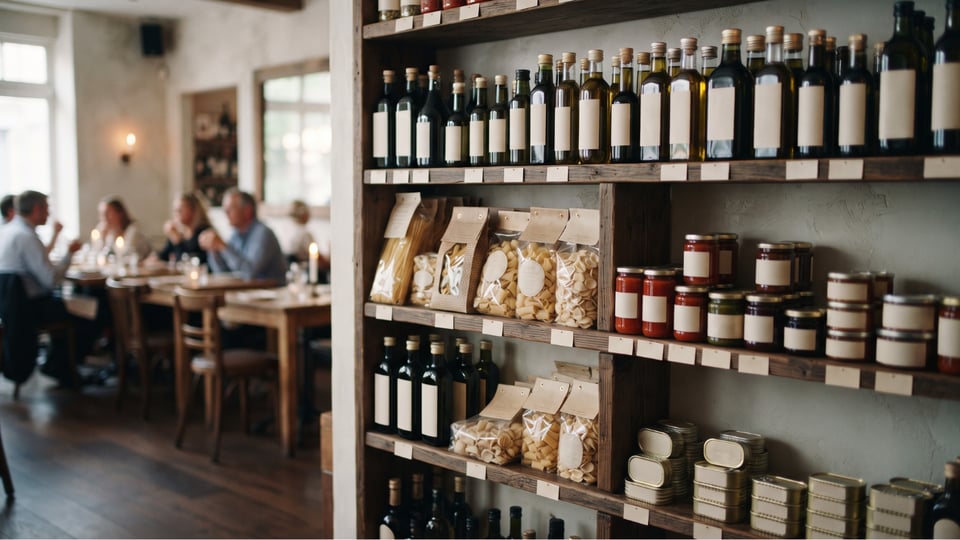
Every restaurateur who has walked through Eataly has had the same thought: I could do a small version of this. A wall of imported pasta by the host stand. Olive oil next to the register. Your house sauce in a jar, going home in a tote bag.
The instinct is right. The execution is where most attempts quietly die.
The line between restaurants and retail is blurring fast. In a 2024 Toast survey of 755 restaurant decision-makers, 43% of restaurants said retail is rising in importance over the next year, and 17% plan to add retail as a new service model. Consumers are pulling in the same direction: 60% say they are interested in signature sauces, condiments, or dressings from restaurants, and nearly all of them say they would buy a retail version if it existed, according to Datassential.
And the economics are hard to ignore. The average restaurant runs on a pre-tax margin of roughly 5% of sales, and 42% of operators reported their restaurant was not profitable in 2025, per the National Restaurant Association. Meanwhile, the Specialty Food Association found that specialty food products deliver a 50.1% return on inventory investment for retailers, versus 19.8% for mainstream products, a 2.5x difference. A shelf of well-chosen specialty products is one of the highest-margin square feet a restaurant can own.
But a market section is not a side hustle you can bolt on with a case of imported crackers. Here is what it actually takes.
What Eataly actually figured out (and what everyone copies wrong)
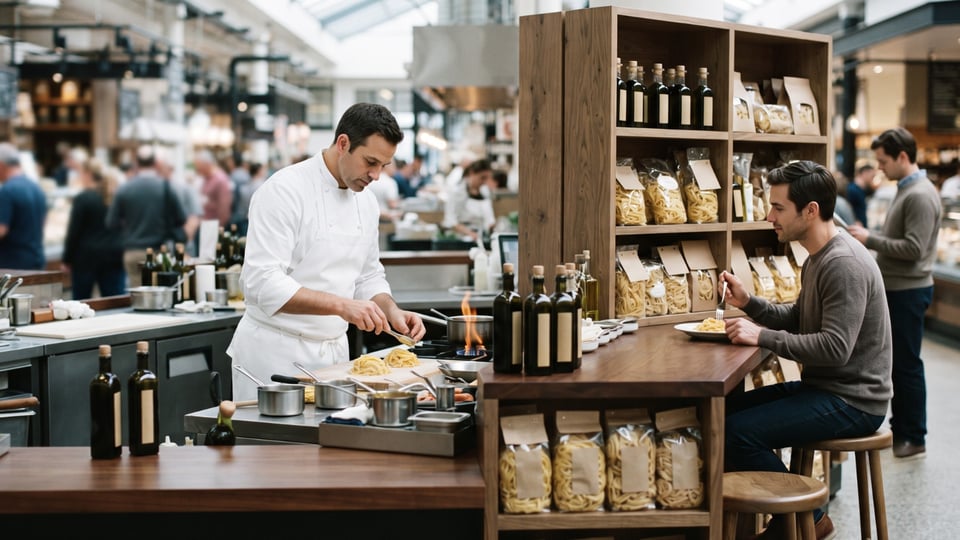
Eataly did €684 million in revenue in fiscal 2024, and at its New York Flatiron flagship it was reportedly generating around $1,700 in sales per square foot back in 2017, more than double a typical grocery store.
What people copy is the shelving. What they should copy is the system: eat, shop, learn. At Eataly, the fish restaurant sits next to the fishmonger. The pasta counter sits next to the dry pasta aisle. You taste something at dinner, learn why it is special, and take it home. Every plate served is a product demo.
That mechanism scales down beautifully. The 50,000 square feet does not need to. Steal the mechanics, not the footprint.
Why most restaurant markets fail: the dusty pantry problem
US Foods put it bluntly in its guide to the grocerant trend: in most cases, packages of food become a dusty pantry. The retail sections that work, they note, stock hard-to-find items aligned with the restaurant's brand that customers actually ask about. The ones that fail sell generic products nobody came there to buy.
The failure pattern shows up at every scale. Most of the restaurants that converted dining rooms into grocery shelves in 2020 dropped them once dining recovered, because they were survival hacks, not merchandised concepts. And at the venture-funded extreme, Foxtrot, the upscale cafe-market hybrid chain, raised over $160 million and abruptly closed all 33 stores in April 2024. Beautiful branding and curated shelves cannot overcome broken economics.
Here is the good news: as a restaurant adding a market corner, you have the one advantage Foxtrot never had. Your rent is already paid, your foot traffic already exists, and your kitchen is already marketing the products. The five points below are what separate the markets that compound from the shelves that gather dust.
1. Know your customers before you buy a single case
The first question is not "what should I stock?" It is "will my guests understand why this is special?"
A $22 bottle of estate olive oil is an easy sale to a diner who just tasted it on your burrata, and an intimidating mystery to one who has not. If your customers do not yet know the difference between supermarket balsamic and aged balsamic from Modena, your market's job is to teach them, and your menu is the classroom.
The safest starting inventory is the one your kitchen already vouches for: the pasta you actually plate, the olive oil you actually finish with, the sauce your regulars ask about. This is also where the demand data is strongest. Datassential found that interest in taking restaurant flavors home is nearly universal among guests who love a signature item.
There is a reason sampling is the most powerful tool in food retail: 70% of shoppers say they are more likely to buy a product after trying it, and a single in-store demo has been shown to lift a product's sales by 475% on event day. A restaurant runs the world's most persuasive sampling program every single night, at zero incremental cost. "As seen in your pasta" outsells any shelf talker a grocery store could print.
2. Put a price tag on everything, no exceptions
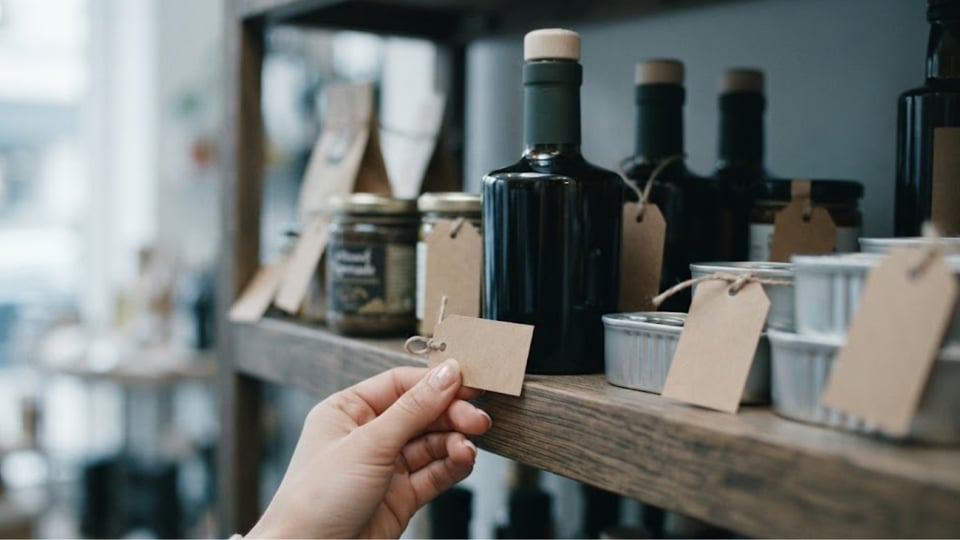
Walk into a shop where imported products sit unpriced and watch what customers do: nothing. They will not flag down a busy host to ask what the olive oil costs, and they will quietly assume the answer is "more than I want to pay." Unfamiliar products plus unknown prices equals intimidation, and intimidated browsers do not become buyers.
Clear, visible pricing on every single item is non-negotiable. It also forces you to price deliberately. The standard starting point in specialty retail is keystone pricing: doubling your wholesale cost, which yields a 50% gross margin. For harder-to-find imports and artisan products, 2.5x cost is common, and that is exactly the 50-60% gross margin band that specialty products typically command, well above the 30-40% typical for everyday staples. Do not price your market like a supermarket. Your guests are not buying a commodity; they are buying the thing they just fell in love with at dinner.
3. Treat it as a business line, not a pet project
This is the single biggest predictor of whether a restaurant market survives its first year. Somebody on your team has to own it, by name.
Owning it means: restocking and facing shelves daily, rotating stock so the oldest best-by dates sell first, watching what moves and cutting what does not, and keeping the section spotless. A dusty shelf reads as "nobody buys this," and it kills the entire section's credibility.
The workload is real but modest at small scale. Retail operations guides put it at roughly 10-20 minutes a day for visual checks and restocks, plus 1-2 hours a week reconciling counts and reviewing slow movers. Call it 2-4 hours a week for a 30-50 product section. If nobody on your team can commit that, you are not ready for retail, and that is a cheaper lesson to learn now than after you have bought the inventory.
On the systems side, this got dramatically easier: your existing restaurant POS almost certainly handles retail products now. Toast Retail lets operators ring up food and retail in one transaction, track stock levels, and get reorder alerts; Square offers the same through Square for Retail. Adding a market is a settings project, not a hardware purchase.
4. Educate, because curation without explanation is just clutter
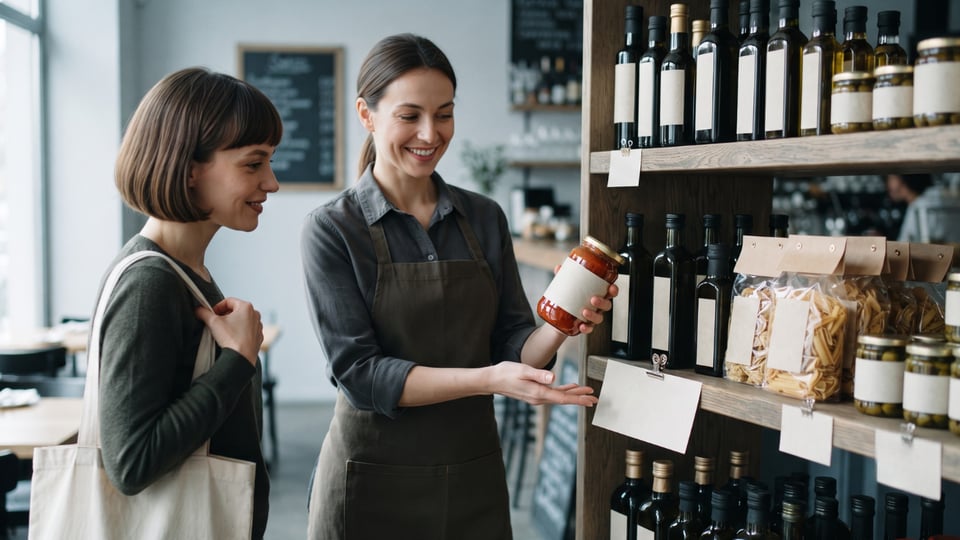
Nobody needs another shelf of pasta. What guests cannot get anywhere else is your palate: why you chose this producer, what makes this pecorino different, what to cook with that jarred sauce on a Tuesday night.
This is Eataly's real engine, and it costs almost nothing to replicate:
- Shelf talkers that connect shelf to menu. "The olive oil in your carbonara" is the most credible endorsement in retail.
- Origin stories. A three-line card about the family mill in Abruzzo turns a commodity into a souvenir.
- Menu callouts. A single line at the bottom of the menu ("Love the sauce? Take a jar home from our market") converts diners who would never browse on their own.
- Staff fluency. If a server can answer "what makes this one special?" in two sentences, the sale closes itself.
5. Decide where the market physically lives
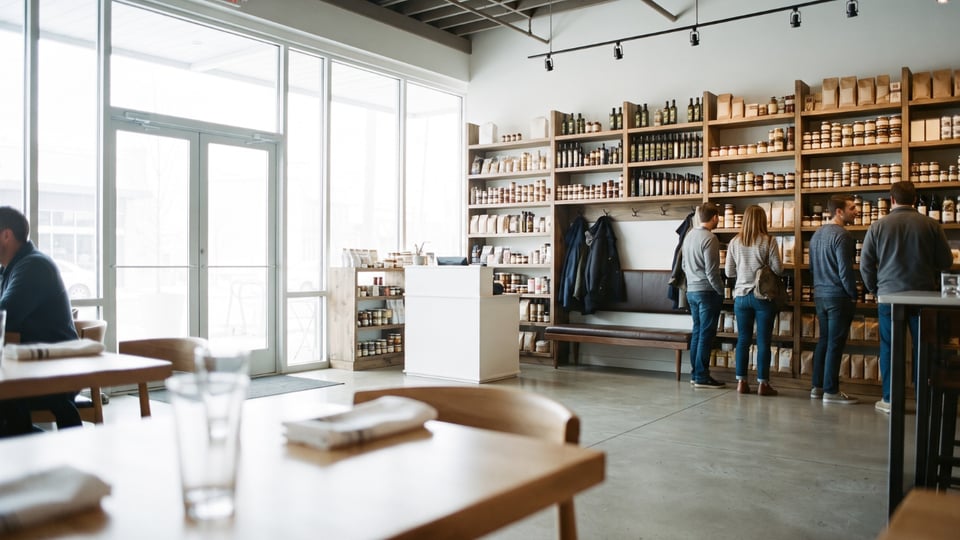
Placement determines whether your market gets browsed or ignored. The successful examples cluster around three patterns:
- At the entry, visible from the street. Gran Caffe L'Aquila in Philadelphia put its market at street level on the ground floor, where every person entering or leaving walks through it (more on them below).
- In the waiting and bar area. Guests waiting for a table are a captive audience with idle hands and an appetite. Shelves they can browse while they wait turn dead time into discovery time. At Kelly's Market in Culver City, a former barista station became a wine bar where locals drink bottles straight off the retail shelves.
- In sightline of the dining room. Some operators face shelves toward the tables so guests eye the products all through dinner. By dessert, the bottle of olive oil they have been looking at for an hour feels familiar rather than foreign.
The one placement that reliably fails is the afterthought corner: a back wall nobody passes, restocked whenever someone remembers. If the market is not on the natural path of your guests, it does not exist.
Case study: Gran Caffe L'Aquila, Philadelphia
If you want proof that a restaurant can run a serious market without Eataly's budget, look at Gran Caffe L'Aquila on Chestnut Street in Philadelphia.
The story behind it is remarkable on its own. The original Gran Caffe L'Aquila stood on the main piazza of L'Aquila, Italy, and was named one of Italy's best cafes before the city was devastated by the 2009 earthquake. Rather than wait decades for the city center to be rebuilt, gelato world champion Stefano Biasini, coffee roaster Michele Morelli, and Philadelphia restaurateur Riccardo Longo rebuilt the cafe in Philadelphia, with an interior designed and built in Italy, opening on Chestnut Street in December 2014.
Then came 2020, and the team transformed again. As the Philadelphia Inquirer reported, they converted the first-floor cafe seating into an Italian market, with grocery shelves where tables once stood, a wine and beer shop in a dedicated section at the back, and cheeses and salumi sliced to order. The market launched online with about 120 products and a plan to grow toward 500.
Three details make it a masterclass for any restaurateur:
- Curation with a point of view. The shelves are organized by Italy's 20 regions, stocked with the products you would find in shops in those regions. That is not a pile of imported goods; that is a guided tour.
- The market and menu feed each other. Rotating regional themes tie what the kitchen serves to what the shelves sell, so dining and shopping reinforce each other, the same flywheel Eataly runs at 50,000 square feet.
- It earned its square footage immediately. Within a week of opening, owner Riccardo Longo told 6abc the market had exceeded expectations, saying "new business is outpacing our traditional business", and that he expected it to help bring staff back.
And the model is not unique to Italian imports. At Fatty Mart in Los Angeles, chef David Kuo's market operations contribute 40% of revenue alongside his restaurant business. His sweet spot, in his own words: "We sell 30-40 pre-packaged hard goods, which have high margins and give us the best bang for our buck."
The start-small playbook
You do not need a buildout. You need a shelf, a plan, and an owner.
- Start with 30-40 products you already use, serve, or genuinely love. That is the range operators like Fatty Mart's David Kuo call the high-margin sweet spot.
- Price everything visibly at 2x-2.5x your cost, keeping you inside the 50-60% specialty margin band.
- Assign an owner and budget 2-4 hours a week for restocking, rotation, and review.
- Place it where guests already linger: the entry, the waiting area, or in view of the tables.
- Connect it to the menu with shelf talkers and a menu callout, and let every plate do the selling.
- Review monthly and cut ruthlessly. Anything that has not sold in 60-90 days comes off the shelf. Curation is what you say no to.
The hardest part used to be sourcing: distributors wanted case minimums and pallet commitments that made a 40-product test impossible for a single restaurant. That is exactly the problem a wholesale marketplace solves. Gourmet Food Marketplace carries thousands of specialty and imported products with no order minimums and full best-by-date transparency, which means you can stock one shelf, see what your guests actually buy, and reorder only the winners.
Your dining room is already the best product demo in retail. The only question is whether there is a shelf nearby when your guest says, "I wish I could take this home."
Sources
- Toast, "Retail Meets Restaurants" (Feb 2025)
- National Restaurant Association, 2026 State of the Industry press release
- Specialty Food Association, "Understanding the Real Value of Specialty Foods, 2024 Edition"
- Datassential, Signature Sauce Trends 2025
- ESM Magazine, "Eataly Sees 4% Revenue Growth In 2024"
- The Robin Report, "It's a Store! It's a Restaurant! It's Eataly" (2017)
- US Foods, "Meet the Mash-Up of a Grocery and Restaurant"
- Restaurant Business, "Retail-restaurant hybrids Foxtrot, Dom's cease operations" (Apr 2024)
- Philadelphia Inquirer, Gran Caffe L'Aquila market coverage (June 2020)
- 6abc Philadelphia, Gran Caffe L'Aquila recovery story
- Repsly, "How Food Demos Increase Sales"
- Retail Dogma, "Keystone Pricing"
- POS Nation, "How to Manage a Retail Store"